

Donald Trump’s zero-sum approach to trade policy brings financial pain to key European sectors, though a few stand to benefit. Here is our list of winners and losers.
The reality of a second Trump presidency carries stark implications for Europe. His administration’s approach to trade will likely bring a revival of tariffs and protectionist measures targeting European industries, potentially escalating tensions with key EU economic sectors. On 20 December 2024, Trump issued a fresh threat of a trade war to the European Union, urging Europeans to purchase more American oil and gas or face a barrage of tariffs. More recently, he angrily denied reports that his new administration and transition team was planning to water down plans to apply sweeping tariffs on imported goods.
While it will take time to discern what tariffs Trump will impose and how the effects of such will manifest across the European economy, it is possible to make some informed predictions on which economic sectors stand to gain the most from the second Trump administration, and conversely which are likely to lose the most.
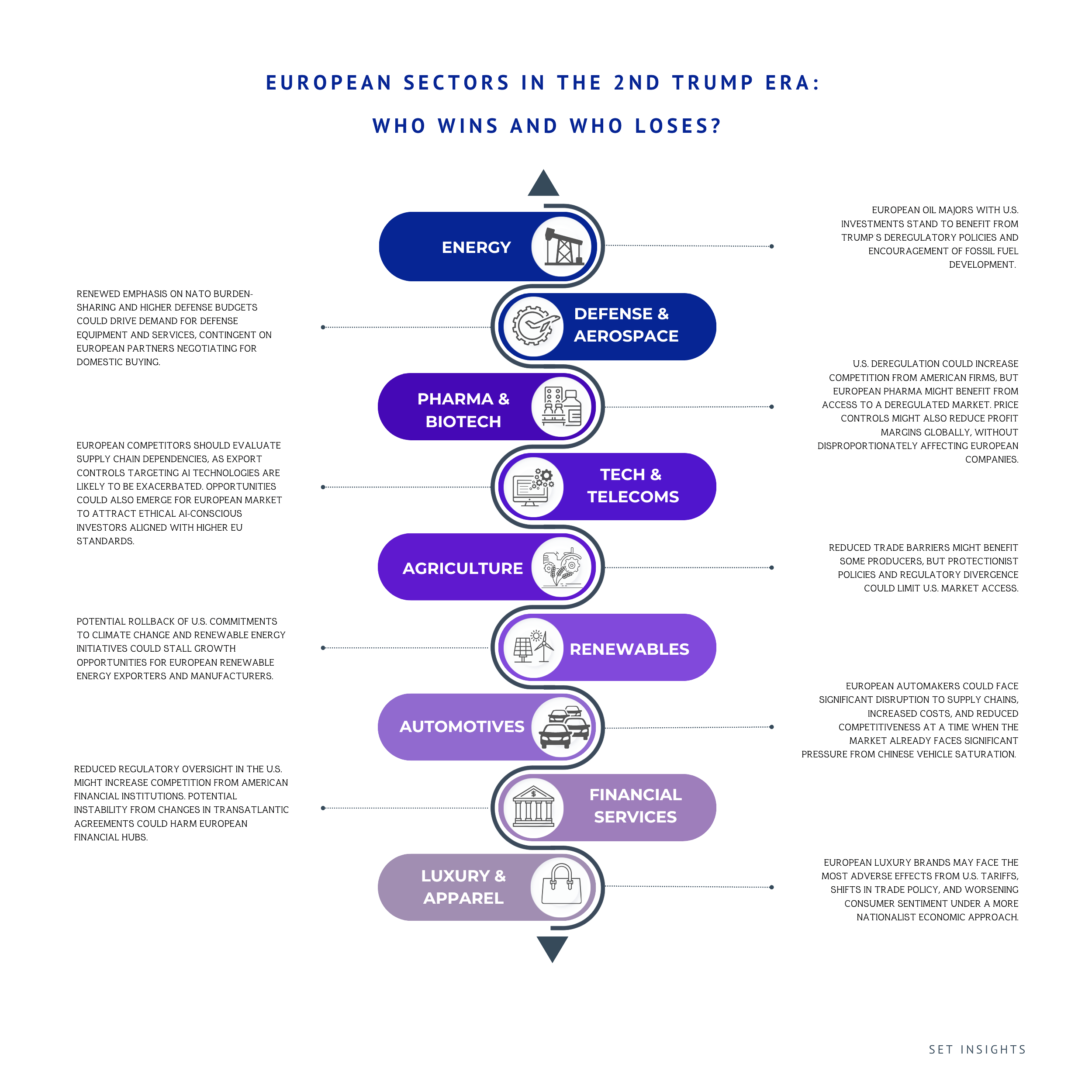
For this purpose, we have compiled a list of likely winners and losers across the European economy during Trump’s second presidency. This list is not a comprehensive list of all economic sectors. Simply, this is a ranking of the nine sectors we have deemed most relevant given the economic landscape in the next four years. We have organized them into three separate categories, namely those which stand to gain the most, those which will feel a neutral or mixed impact, and those who, in our view, will be the big losers.
Stand to Benefit the Most
Energy
Trump’s deregulatory policies and encouragement of fossil fuel development may indirectly benefit European oil majors like Shell, BP, and TotalEnergies, particularly those with U.S. investments and those exporting energy equipment. In addition, a push for Europe to reduce dependency on Russian natural gas could lead to higher imports of U.S. liquefied natural gas (LNG), benefiting European energy companies engaged in LNG infrastructure. Furthermore, reduced focus on global climate agreements might ease pressures on fossil fuel industries.
Defense and Aerospace
Trump’s tactic of threatening security partners can also harm U.S. commercial interests as EU partners may choose to decline U.S. arm sales and seek to buy from European arms makers. European partners will feel less inclined to take a cautious approach in hitting back at U.S. industry if the incoming Trump administration uses tariffs and pressure on security partners as more than threats in negotiations.
Neutral or Mixed Impact
Pharmaceuticals and Biotechnology
Under President Trump’s administration, a focus on deregulating the U.S. pharmaceutical sector could significantly alter competitive dynamics for both domestic and international companies. Such deregulation may lower barriers to innovation and market entry, intensifying competition from American firms. This increased competition could challenge European pharmaceutical companies, especially those accustomed to operating in highly regulated environments. This partly explains why European drugmakers saw a collective loss of 6% in equity markets post-Trump’s win. However, a deregulated U.S. market might also offer opportunities for European firms through collaborations with American counterparts, expanded market access, and streamlined approval processes, enabling them to leverage their expertise in specialized areas.
Concurrently, the implementation of price control measures in the U.S. could compress profit margins across the global pharmaceutical industry. Given that the USA accounts for a substantial portion of global pharmaceutical profits – estimates suggest between 64% and 78% – reductions in U.S. drug prices could significantly impact overall industry revenues. European pharmaceutical companies, already accustomed to operating under stringent pricing regulations in their domestic markets, might be better positioned to navigate these pressures compared to their American counterparts. Nonetheless, the combination of deregulation and price controls presents a complex landscape, offering both opportunities and challenges that demand strategic adaptation.
Technology and Telecommunications
Trump’s second administration will significantly reshape the transatlantic technology landscape, creating both challenges and opportunities in this sector. Data privacy standards in Europe (GDPR) could clash with deregulated U.S. approaches, creating trade tensions. However, cross-Atlantic tech partnerships might still thrive in areas like AI and cybersecurity.
Europe’s investments in this sector aim to reduce reliance on dominant players like the U.S. (NVIDIA) and East Asia (TSMC). The European Chips Act explicitly prioritizes R&D in AI-optimized chips, potentially positioning firms like Infineon and NXP Semiconductors as leaders in this space. European competitors should evaluate supply chain dependencies, as U.S. export controls – targeting advanced semiconductors and related technologies – are likely to be exacerbated under Trump.
The Trump administration’s likely emphasis on unregulated AI development could create transatlantic competition. However, opportunities could emerge for the European market to attract ethical AI-conscious investors, venture capitalists and private equity firms looking for emerging AI startups aligning with higher EU standards, as they may capture market share in more regulated markets worldwide.
Agriculture and Food Production
The European agriculture and food production sector is set to face significant challenges in the years ahead. In 2019, Trump imposed tariffs on key European agricultural exports like wine, cheese, fruit, and olive oil. A second Trump administration might continue or expand such measures, making it harder for European producers to compete in the U.S. marketplace.
Regulatory divergences between the U.S. and EU, particularly regarding food safety standards, GMOs, and hormone-treated beef, might also create additional barriers if the Trump administration pushes for changes to EU rules as part of trade negotiations. Furthermore, Trump’s preference for bilateralism over multilateral agreements could weaken the EU’s collective bargaining power, forcing individual member states to manage trade disputes on their own. Export-reliant sectors, such as French wine and Italian olive oil, would remain particularly vulnerable to heightened tariffs or retaliatory measures, increasing risks for European producers dependent on the U.S. market. Broader trade tensions could also spill into other economic sectors, complicating EU-U.S. relations and creating uncertainty for exporters. Domestically, the EU may need to strengthen mechanisms such s the Common Agricultural Policy (CAP) to protect farmers from external shocks and ensure the sector’s stability in the face of unpredictable U.S. trade policies.
However, there could also be opportunities for European agriculture under a second Trump presidency. Bilateral trade agreements might reduce tariffs on certain products, such as wine, cheese, or specialty foods, improving access to the U.S. market for these sectors. Streamlined regulatory processes, such as mutual recognition agreements, could benefit European exporters in areas like dairy and processed foods. Additionally, trade negotiations might open up new avenues for high-demand European goods, particularly those with strong branding, such as products with Protected Designation of Origin (PDO) status. In response to U.S. trade policies, the EU might enhance its focus on sustainability and internal agricultural support systems, improving the sector’s long-term resilience. Furthermore, European producers could use this period as an opportunity to diversify their export markets, reducing reliance on the U.S. and mitigating risks associated with volatile trade relationships.
Stand to Lose the Most
Renewables
The renewable energy sector faces significant market risk from the potential policy changes that a second Trump administration might pursue. Trump and his transition team have given clear indications of wanting to leave The Paris Agreement on climate, which would entail undoing pledges to limit emissions. Furthermore, they have also voiced opposition to Biden’s flagship Inflation Reduction Act (IRA), a federal law that has promoted clean energy investments through massive subsidies and incentives. European offshore wind developers and turbine makers, as well several other European utility companies face exposure to risks in this space. Indeed, following the confirmation of Trump’s election win, European clean energy stocks took a tumble, with wind energy companies Orsted, Vestas, and Nordex seeing major price action, as well as Germany’s top power producer RWE and even Portugal’s EDP Renováveis. The expansion of the U.S. renewables market enshrined in the IRA had recently been a key growth sector for several of these European energy companies.
Automotives
European trading partners are already expressing significant concern over Trump’s proposal to impose a universal 20% tariff on imports. European automakers, including major players like Volkswagen and BMW, rely heavily on the U.S. market, and such tariffs could disrupt supply chains, increase costs, and reduce competitiveness at a time when the market already faces significant pressure from a danger of Chinese vehicle saturation. Trump has also made public remarks demanding that European automakers move their manufacturing capabilities to the U.S. so as to hire American workers in exchange for access to the American market. This could present logistical challenges and lower margins for European car companies.
In parallel, discussions about reducing or eliminating electric vehicle (EV) subsidies in the U.S. are underway. Notably, Tesla CEO and Trump advisor Elon Musk has expressed support for ending the USD 7,500 EV tax credit, suggesting that the market should not rely on government incentives. This potential policy shift could diminish the competitive edge of American EV manufacturers who have benefited from these subsidies. In contrast, European luxury car manufacturers, known for their strong branding and market resilience, may continue to experience stable demand. Their established reputation and consumer loyalty could help them navigate the challenges posed by both the proposed tariffs and changes in subsidy policies.
Financial Services
Reduced regulatory oversight in the U.S. could intensify competition from American financial institutions, with marked negative impact for European counterparts. A deregulatory environment may enhance the operational efficiency and profitability of U.S. banks, enabling them to offer more competitive services and products. This scenario could challenge European financial institutions, which often operate under stricter regulatory frameworks, potentially affecting their market share and profitability.
Additionally, potential instability arising from changes in transatlantic agreements could undermine European financial hubs. Disruptions in cross-border trade, investment, and regulatory cohesion may erode the interconnectedness of global markets, increasing uncertainties for European firms. For instance, the UK’s departure from the EU led to significant shifts in financial activities, with Amsterdam surpassing London as Europe’s largest trading center for a period.
To mitigate these risks, European financial institutions might focus on strengthening their regulatory frameworks, fostering innovation, and expanding into less volatile markets to ensure stability and resilience. Addressing excessive regulation and reducing bureaucratic complexities could enhance competitiveness and attract investment.
Luxury Goods and Apparel
European luxury brands may face the most adverse effects of U.S. tariffs, shifts in trade policy, and evolving consumer sentiment under a more nationalist economic approach. Tariffs of up to 20% on imports could make European luxury goods more expensive for American consumers, potentially decreasing demand. Economic sector forecasts already prophesised a 2% drop in global sales of personal luxury goods in 2025, marking the first annual decline since the Great Recession. These tariffs could exacerbate the downturn, making European brands prohibitively expensive in the U.S. market. A rise in nationalist sentiment among U.S. consumers may further exacerbate this trend, encouraging preferences for domestic products. To navigate these challenges, brands could explore strategies like relocating production to the U.S., emphasizing their heritage and craftsmanship, and diversifying into emerging markets with growing affluent populations. These measures can help mitigate potential losses while adapting to the changing economic and cultural landscape.
This analysis is a contribution made by Ricardo Morais, Senior Analyst at SET Advisory.